
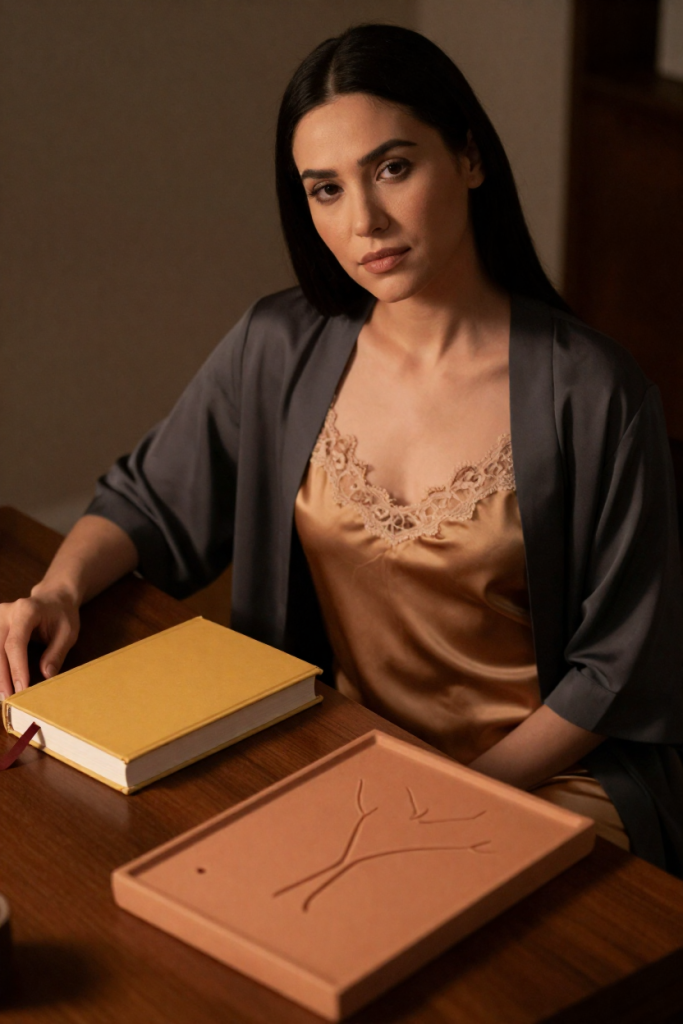
The first family trees were pressed into wet clay as branching lines. Ours still are — grooves, not letters.
Lines before language. A branch groove is the oldest mark a family can make: a stem dividing, dividing again. It carries the shape of descent without a single name, date or word. Our tablet keeps exactly that mark and nothing more — smooth shallow curves in unfired clay, pressed by a rounded tool, never a stylus cut into wedge-shaped script.
The distinction is a hard rule of this desk. Wedge marks, pictograms and symbols are writing by another road, and writing on a prop is culled wherever it appears. Abstract grooves can be read by no one, which is precisely what makes them honest in a studio of fictional lives.
Briefing unfired clay. Say ‘shallow smooth curved branch grooves only, no wedge marks, no symbols, no markings’, and mean it. If a generation scores the tablet with anything resembling script, discard it — even beautiful script. The tablet is a drawing of a tree, not a document from Babylon.
Keep the tablet small and at the desk’s edge. It is the oldest object in the room and should behave like an elder: present, quiet, never centre-frame.