
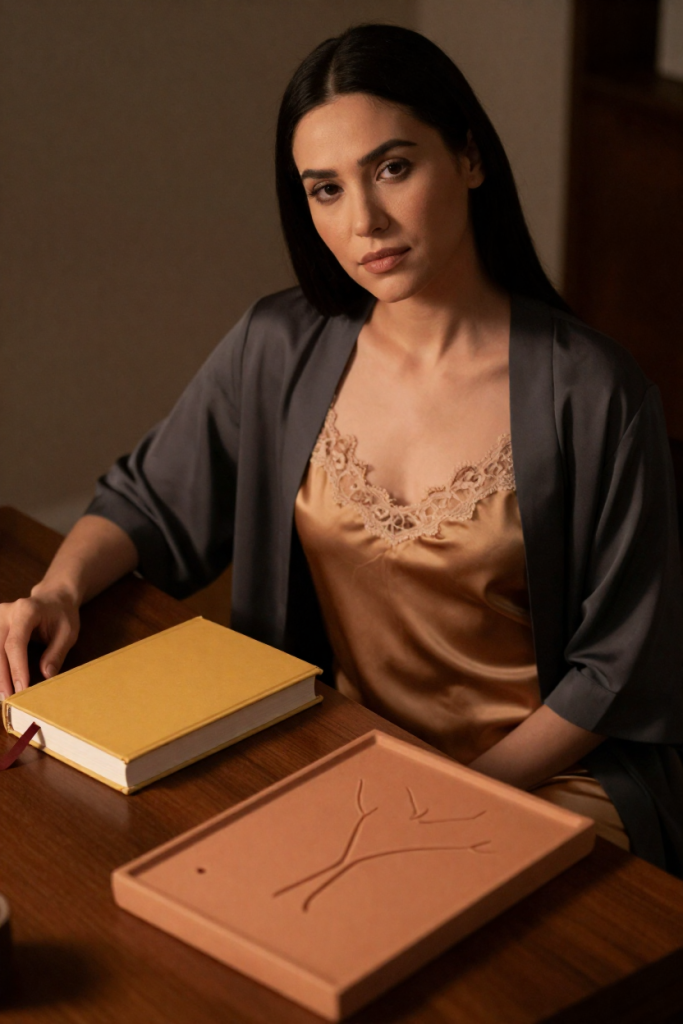
Hang the framed tree on the wall and you get the studio’s idea at distance. Press it in clay on the desk and you get it at arm’s length.
Two scales of one mark. The wall chart and the clay tablet carry the same drawing: abstract branching lines, no names, no dates. One is ink on paper behind glass; the other is a groove in earth. Between them the sitter is framed by ancestry at both ranges — near enough to touch, far enough to contemplate.
That doubling is deliberate composition. A single repeated motif, changed in material, gives a gallery its family resemblance without a single word of branding. Visitors learn the mark the way they learn a face: by meeting it twice.
Keeping both honest. Both versions stay abstract for the same reason — every life here is fictional, and a named ancestor, in ink or in clay, would be a forgery. Bare branches are a shape of belonging that no archive can contradict.
When briefing, describe the chart as ‘bare abstract branching lines’ and the tablet as ‘branch grooves’. Never call either a document, a record or an inscription; the words you choose are the ones the render believes.